
Retatrutide Quick Reference (5 mg Vial)
- Vial contents
- 5 mg Retatrutide
- Final volume
- 1 mL
- Concentration
- 5 mg/mL
- One U-100 unit
- 50 mcg in 0.01 mL
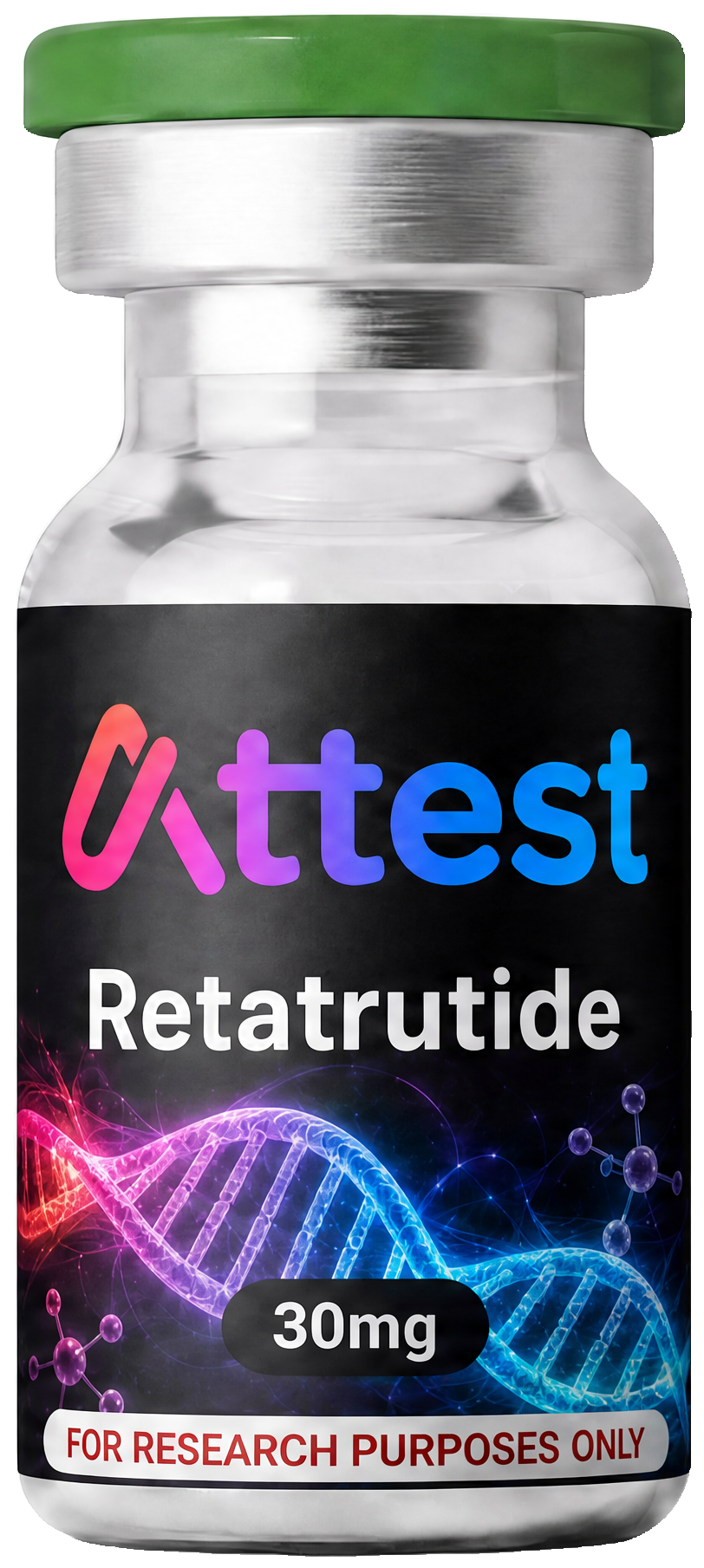 Actual Attest 30 mg vial image. Model strength is shown separately.
Retatrutide Dosage Chart (5 mg Vial)
Two published study schedules translated into the selected vial's concentration. These are descriptions of monitored trial arms.
Phase 2 Trial Schedule (5 mg/mL)
| Study Phase | Weekly Dose | U-100 Units | Volume |
|---|
Study frequency: Once weekly, subcutaneous, in the lower-start 12 mg arm of the phase 2 obesity study. Other groups had different targets and starting amounts. [1] [2]
Phase 3 Trial Schedule (5 mg/mL)
| Study Phase | Weekly Dose | U-100 Units | Volume |
|---|
Study frequency: Once weekly, subcutaneous. The table follows the 12 mg target arm; separate groups ended at lower targets. [3] [4]
Reconstitution Steps
Rows above one vial or 100 U-100 units are flagged. The study material and clinical oversight are separate from this vial arithmetic.
Supplies Needed
Minimum arithmetic quantities for the illustrated 12 mg target-arm schedules over 12 and 24 weeks.
Vial totals use total nominal mass across the period. Water totals assume one modeled final volume per vial. Capacity equivalents sum the rounded-up 1 mL volume requirements per study week. *Swabs model two per capacity equivalent. These figures exclude losses and formulation-specific discard limits; they do not prescribe preparation or administration.
Actual Attest 30 mg vialModel: 5 mg nominal massPeptide Reconstitution Simulator
Explore the nine-step preparation model. It tracks your selected vial mass and final volume, with feedback and a summary at the end.
Practice Reconstitution
Follow nine guided steps and review the model assumptions at the end.
30 mg product imageModel: 5 mg
Educational model. Follow exact product documentation for a real vial.
Retatrutide Vial and Research Context
Protocol Overview
- Phase 2 obesity research evaluated placebo and 1, 4, 8 and 12 mg target groups. [1]
- TRIUMPH phase 3 programs evaluated 4, 9 and 12 mg targets across defined populations. [3]
- The chart displays selected 12 mg target arms, not every trial group.
- Changing vial strength changes concentration and measurement only. The historical study schedule stays fixed.
Dosing Protocol in Published Studies
The phase 2 lower-start arm progressed through 2, 4, 8 and 12 mg; the phase 3 12 mg target arm progressed through 2, 4, 6, 9 and 12 mg, in four-week stages. [1] [2] [4]
These sequences describe study designs with eligibility criteria, investigated formulations and clinical monitoring. They are not selected by the calculator.
Storage Instructions
- Before preparation: Follow the exact vial's documented temperature, moisture and light requirements.
- After preparation: Use the documented storage conditions and discard period for that formulation and diluent.
- Label: Record concentration, preparation date and the supplied storage/discard instructions.
- Model limit: No general shelf life is inferred from vial size or arithmetic coverage.
Retatrutide Reconstitution and Vial Yield
Compare nominal vial yield and volume for the study amounts at the selected concentration.
| Amount | U-100 units | Volume | Full portions / vial | Remainder | Nominal vials needed |
|---|
How to Reconstitute the Modeled Vial
- Verify: Confirm total mass, exact formulation and the laboratory procedure.
- Prepare: Gather the specified supplies and establish the documented clean preparation workflow.
- Define volume: This illustration uses your entered final liquid volume. Check compatibility before any real preparation.
- Mix and inspect: Follow the exact mixing and inspection requirements from the product documentation.
- Label: Record the concentration and preparation/storage details.
- Check arithmetic: Recompute the chart whenever vial mass or final volume changes.
Retatrutide Dose Escalation in Human Trials
Trial escalation is tied to assigned target groups and controlled monitoring. Phase 2 had multiple starting approaches, while the phase 3 sponsor describes planned four-week increments to assigned targets. [1] [4]
The two charts preserve those distinct designs. A 5 mg vial does not establish a 5 mg study target.
How Retatrutide Works in Metabolic Research
Retatrutide is being investigated as a single molecule acting at GIP, GLP-1 and glucagon receptors. The TRIUMPH program studies metabolic outcomes in defined populations. [3]
Receptor activity and vial concentration answer different questions: mechanism describes biological research, while this page's calculator describes nominal mass and volume.
Retatrutide Clinical Trial Findings
The 48-week phase 2 obesity trial reported dose-related body-weight changes. The TRIUMPH design describes subsequent controlled studies across obesity and related conditions. [1] [3]
Read the original results and study methods for population, endpoints and uncertainty. This vial model does not predict an individual's outcome.
Retatrutide Safety and Research Limits
The phase 2 trial reported gastrointestinal adverse events and dose-dependent heart-rate changes. Trial findings belong to the investigated formulation and monitored participants. [1]
Retatrutide remains investigational. The arithmetic does not verify an Attest lot's identity, purity, sterility, stability or equivalence to trial material. [5]
Frequently Asked Questions
- What volume does the default chart use? 1 mL final volume. Change the volume field to recalculate.
- What does one U-100 unit mean? 0.01 mL; peptide mass depends on concentration.
- Does vial strength change the study schedule? No. It changes nominal mass, concentration and yield.
- Why are some rows flagged? They exceed the nominal mass in one vial, the 100-unit scale, or both.
- Can the simulator validate a real preparation? No. It demonstrates a sequence and arithmetic assumptions.
Important Research Note
This page models vial strength and measurement while describing published research schedules. It does not choose a dose, supply a clinical protocol or establish a storage period. Retatrutide is investigational.
References
- 1NEJM: phase 2 obesity trialView source
- 2ClinicalTrials.gov: NCT04881760 study armsView source
- 3TRIUMPH registrational trial designView source
- 4Lilly: phase 3 study escalation and targetsView source
- 5Lilly: investigational Retatrutide contextView source